What types of Weeding Tools, Weed Pullers, Weed Poppers, Weed Twisters, Weed Hoes
or other Garden Weeders do You Need? Special Weed
Problems in your State or Region?
How Big
are your Weeds? Match your tools with the most troublesome weeds in your garden
or state... Need a Back-Saving Solution?
How many different
Weed Twister Tools
are there? How to select a
matching drill (not
free!) for garden augers
and twisters?
Learn about weed types - free downloads from Ergonica:
In gardening and farming today there's a
buzz about new techniques and tools for organic crops, permaculture, sustainable
agriculture and improved safety, including no-till and low-till practices. You may be curious to know if there is
anything really new in the weeding tool department to go along with a new
commitment to freshen up your garden or perhaps create a new native plant garden
from a converted lawn. With that in mind, you may be ready to upgrade your
conventional (old fashioned?) hoe to a more precise hoe and/or weed puller or
twister that protects your herbs as well as your
soil from excessive tilling. Perhaps you're ready to put aside your
habitual herbicides to come clean from chemical dependence. You may also
be curious about ads and commercials for
different types of weed twisters and augers that promise to save you time and
save your back, as well. We think you will be pleasantly surprised by
several really cool tools that may be new to you and to many others who haven't
yet ventured beyond the traditional hoe and dandelion digger for defending
against weeds. Do you need more diversity and power in your weeding
tool arsenal?
Weeding wisdom: Mulch
preventive, Twist defensive - Stow the Hoe until you Sow!
Do you need to remove weeds by their
roots, or simply whack off their tops? To help you get a hold of the weeding tool
marketplace, we begin with a way to more clearly describe and classify all the types of hand tools
for weeding so that you understand the difference between a weed twister, an
auger and a twisting cultivator, or a weed popper and weed puller. This
will help you see through the hype of commercials and look for the types of
tools that will help you the most based on what's actually going on in your
garden and the way you prefer to work with weeds. While reading this
page, we suggest you turn off your TV infomercials!
Chances are you are beset with weeds of a
variety of different types, sizes and shapes. By choosing the right
tools, you will be more successful in matching up with your most stubborn weeds.
With two or three carefully selected hand tools, and a little work, you will
be able to protect your precious herbs and crops without the need to resort to a
chemical overkill. A good tool match also must consider the
size, shape and placement of the plants you're trying to protect. Wouldn't
it be nice to find some tools to save your back and save some precious time as
well?
Different weeders for different weeds! Compare features and prices!
Most gardeners need special tools
designed to work effectively within each of two or three of the Weeding Tool Terrains.
For each terrain you may need one or two tools to match up
with specific preferences, weeds, situations and types of plants you need to
protect. In some large or complex gardens, four or five terrains may
need the attention of appropriate tools.
Since twisting weeders are hot on the
market today, we talk a lot about the Ergonica Weed
Twister, partly because we manufacture and sell this tool and also because
many people have seen ads about this and similar products and need to know how
this twister differs from other twisters numbering about a dozen or more. This twister also deserves
special attention because its unique design allows it to cross over into several
tool type classifications, making it an exceptional multitasking helper!
For example, in one terrain this tool can very effectively twist out crabgrass and bermudagrass, which few, if any, other tools
can do, earning the nickname Crabgrass Twister
and in another terrain can also uproot small tree sprouts such as the Ailanthus altissima with roots as long as 12 inches and more.
A number of specific weed twisting tools from various manufacturers and others
with little or no twisting options are also compared in some detail below. Very popular
weeders such as weed poppers with foot levers, hula hoes, string trimmers and other varieties are also presented and compared
in some detail. We also offer for sale a number of competing products from various affiliates to keep everyone honest and allow you to
conveniently compare prices and detailed weeder features including comparisons with several Amazon marketers. Amazon comparisons can
sometimes provide better customer reviews than other selling platforms but you may sometimes find better prices from different marketplaces
which you may see in our comparisons.
Are you using the Wrong Weeders
for Your Weeds? Or Your Needs?
Upgrade your Weeder Tool Arsenal with the latest
Garden Gadgets on the market!
When Weeding Tools Don't Match Your Weeds and Your Needs: Weeder Mismatch
Indicators...
Weeds keep on coming back in the same
places
Roots are deep and tools only reach
4-6 inches deep
My tools don't work well with
grassy runners and prostrate vines
Weeder is too large and can't get at
small weeds in narrow spaces
Weeder is heavy and hard to use in
my raised beds and planters
My back is sore from too much stooping
with short handled weeders
I'm in a wheel chair and can't use my
weeders from a sitting position
My knees are sore from using short
handled weeders and knives
Weeds are in my lawn and my
tool elements
are too wide
Weeds are under bushes and can't be
reached with my tools
My tools don't help me much
with air potato vines and kudzu vines
I'm using conventional wide-blade hoes
for permaculture and organic gardening
I'm still using the same old tools my
spouse used many years ago
Using my tools takes more time than I
can afford to use as a parent and homemaker
My tools have been around as long as I
have
A better match starts with a clear
picture of your weeding tools mismatch issues. If you're facing
some of the problems on
this list, be assured that there are better matches for your weeds and needs
identified on this page. The old conventional hoe and other traditional weeding
tools are suitable for certain situations but just weren't designed to match many of the technical and personal problems
faced by homemakers, retired folks and organic farmers today. The older you are, the more
you may need newer, more efficient tools. The concepts of ergonomics,
convenience, multitasking, organic gardening or low-till farming were not
relevant to traditional tool manufacturers. More effort has been devoted
by large corporations and professional engineers to designing heavy machinery and
chemicals for modern agriculture than to making handy garden tools and organic
solutions. The most innovative, problem-solving weeding tools today are made by smaller
companies and entrepreneurs.
The Big Picture in Weeding Hand Tools
In the technical arena for hand tool
weeding, as many as eight
weeding tool classifications, each
ordinarily served best by different tools (with some exceptions), can be seen in
the Weeding Tools Terrain Hierarchy chart below. To
be fair, we try to give a balanced view to clarify all the twisting and
non-twisting alternatives. We also sell many of the competing twisters and
other tools on this website, because we firmly believe that just one type of weeding tool for
the average garden or farm just won't cut it! Different weeders for
different weeds!
Seasonal Weeding Tool Tactics
Early spring: Most gardeners and
farmers want to remove small uninvited sprouts, suckers and seedlings as soon as
possible by their roots, before they go to seed. This will clear the weed
pressure for later seasons when your annual plants and crops are more sensitive
to herbicides. You don't want to spray herbicides around blossoms,
vegetables, carrots, onions, etc., especially after they are mature and ready to
harvest. If you use the tools available for pulling or twisting out early
spring seedlings by their roots, you will reduce or eliminate the need to invest
in heavy equipment, weed whackers and / or herbicides. Hoes can also work
on small seedlings, but be sure that all roots are removed. In farms and
regions where irrigation and precipitation is abundant year round, you may need
to use deep-root extracting tools, twisters and pullers in all seasons.
Rainy seasons start the promise of weeds and the advantage of tools that twist
into the soil.
Mid-summer or fall: Your requirements may extend to weeding tools that are
capable of penetrating deeper than 4-6 inches to remove the tap roots of
vigorous late-season weeds such as mallow or dandelions, for example. If
allowed to mature for more than six months, the roots of many annual and
biennial weeds can extend to 12 inches or more deep into the soil. Hoes
and many foot-lever tools are not designed for mature deep-root extraction at
this time of year. The
main question here is to select the tools that work well for your types of
weeds, your personal preferences or body requirements (ergonomics), and,
especially for farmers, the most efficient tools that do the job quickly and
safely for their workers and their crops (high precision tools).
Is this your season of reason?
Can your work benefit your environment?
Weeding Tools Terrain Hierarchy:
This
is a table that describes from left to right
the major plant types by size and shape, tool types appropriate to each plant
type, terrain targeted by each tool type, and finally the application of the
exceptionally versatile Ergonica Weed Twister within each terrain. This
hierarchy is sorted from the top down with larger plants at the top of the chart
and upper portions of these plants placed above the lower portions and roots.
At the base, aquatic weeds are included as one terrain, although this terrain,
and possibly others, could logically be refined to more specific terrains or
sub-categories, such as different types, shapes and sizes of weeds within each
terrain. For example, the aquatic terrain may be further subdivided into
major plant
communities: emergent plants, floating-leaved plants, submersed plants
and deep water. The codes from A thru H are provided on the leftmost column for convenience in comparing
specific tools in the Weeder Features
chart below. Neither the codes nor hierarchy of terrains is endorsed by
any industry standards. These groupings are intended solely to give the
consumer a practical guide in selecting appropriate tools that match the weeds
they most often need to contend with.
Weeding Tools Terrain Hierarchy
- Eight Major Weeding Tools Classifications
Hand heldweeders
that remove individual plants by their roots are known as weed pullers and
weed
poppers or more generally as weed removal tools. Weed twisters
also fall into this classification. Other terms often used for weed
pullers are weeding tools, weed tools, weed diggers, weed knives, weed
uprooter tools, weed pluck
tools, weed cutter tools, weed pulling tools, weed puller tools, weed removing
tools, weed remover tools, weed extracting tools, weed removing devices, weed
clearing hand tools, garden weed pullers, manual weed pullers, weed twist, twist
weed, garden twister tools, weedtwisters, cork screw weeders, weed removal claws, weed
shovels, tree pullers, root pullers, uproot tools, grass weed pullers, dandelion pullers,
dandelion diggers, dandelion knives, dandelion poppers, dandelion tools,
dandelion extractor tools, dandelion removing devices, crabgrass removal tools,
crabgrass toolsand various combinations of these and similar terms. These
terms may also be useful when searching for specific tools on the web.
As we will explain, these tools have a
number of different features and several offer unique designs to pull out roots
in different ways as is suggested by the many different names by which they are
called. Each puller has to provide a means to penetrate the soil and
/ or to grab or remove the root in some way. Some are complex tools with
moving parts, although most have no moving parts. A few of these tools
also require motors of some type, such as a power drill, for example. Some
of the weed pullers are also designed specifically to remove deeper and larger
roots than others. They also differ in the length of their handles and the
ability to lift the removed plant above the ground to avoid additional cleanup.
Many interesting and diverse tools are included in this group.
Hand cultivators,
like forks, claws and hoes for
example, are also weeders used primarily to remove numbers of small seedlings in patches by partially uprooting
them and cutting their stems at the base. Hoes and claws-forks are cultivating hand tools
in contrast to larger tractor-mounted cultivators or cultivating machines.
Hoes usually have long wooden handles and
are often designed to specialize in weeding larger or smaller areas by the size
and shape of their blades.
The Free Dictionary
defines cultivator as "An implement or machine for loosening the soil
and destroying weeds around growing plants." In a sense, weed pullers,
as described above, are designed to surpass the limitations of hand cultivators
by removing weeds more precisely or with deeper penetration for larger roots, or
both. Cultivators are also tillers and may be used for aeration and
irrigation control, as well. The pros and cons of using cultivators for
weeding will be explored more thoroughly below.
String trimmers and Weed whackers are
power tools that work above ground to cut the stems of grassy weeds.
These tools generally use a rapidly rotating string or stiff element to directly
assault the stems of relatively small grassy vegetation. In recent years a
number of manufacturers have developed cordless electric trimmers with batteries
that can last an hour or more before recharging. Industrial applications
generally use more powerful trimmers with gasoline motors for clearing weeds in
large areas.
Each of these tool type groupings fits into one of the eight weeding tool terrains
described above.
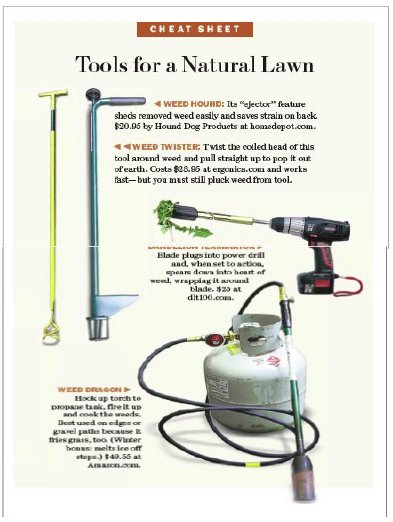
Weeding Tools for a Natural Lawn
The U.S. Patent and
Trademark Office eliminated the category of weeders years
ago. But that didn't discourage many creative gardeners
from coming up with new weeder inventions and occasionally
acquiring patents, to the benefit of the increasing number of
gardening enthusiasts. These are generally categorized as
mechanical weeders. Mechanical weeders and hand tools are becoming more
popular today partly due to the increased interest in organic gardening,
sustainable gardening,
integrated pest management,
permaculture
and the nationwide Master Gardener
movements, all of which which discourage the use of toxic chemicals
for herbicides and pesticides.
The wide use of herbicides
is largely due to the convenience of using chemicals to curtail the growth of
weeds or to kill dandelions and other weeds from lawns and other large
areas. Chemicals can kill plants (targeted or not), but they can't remove
them. So, you're left with dead plants that look unsightly and
still need to be removed after chemical poisoning. Some gardeners have not found a practical tool to
remove dandelions without a great deal of stress on their backs
and limbs. You may be dealing with the same problem
yourself and hope to find a practical alternative to using toxic
chemicals on this web site. Whereas dangerous
chemicals may be economically advantageous on the farm where productivity can
make or break the farmer's success,
there is little economic value to horticulture and ornamental gardening to
offset the risks of applying these killing agents around children and pets at home.
It doesn't make much sense to select premium organic veggies at the
market and take
dangerous pesticides for your herb garden in the same shopping cart! The subject of the economic tradeoffs of herbicides in agriculture and
ornamental gardening is more thoroughly discussed on the
Weed Twister vs. Roundup web page. If
you need a little help to kick the herbicide habit, see the
12 - Step Herbicide Detoxification Program.
Weeder Features
The good news is that there
are several mechanical solutions to removing dandelions from
lawns and removing other types of weeds with very little stress
on your back and limbs. Each tool has
different advantages and may focus on different plant removal
situations. Most tools do what they claim to do fairly
well. Some claim to do a lot of different tasks in various
situations. Others focus on just one task in a specific
setting. Sometimes a feature for one advantage may cost the loss of other
advantages, such as longer length causing more weight, for example. Here
we describe each feature as it applies to a class of tools and the pros and cons
that apply to the features and tools in each class.
Back Saving Hand Tools
The most attractive feature
driving the mechanical weeder market today is the back-saving
feature. The minimum requirement for this claim is a
long handlethat extends for 30 inches or more. The
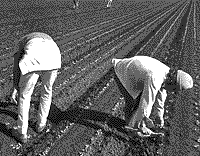
short handled hoe, for example, is infamous in agriculture for damaging the
backs of work hands on the farm. Many states now require that a hand tool
for agriculture have a length of at least 48 inches to protect the health of
farm labor. See the Hand Weeder Science page for
more tips on agricultural solutions.
The Weed God, if there is
such a thing, does not demand that you genuflect on the hard soil every time you
wish to remove an unwanted plant! If your body and the plants in question
are in conflict, you have to decide how much pain you really need to invest in
clearing or removing the weeds. Generally speaking, the longer the handle,
the easier it is for your back. For example, the Ergonica Weed Twister
gives you a choice of several lengths from 36 to 60 inches that you may choose
based on your height and the need to reach away from your path or around various
obstacles. Additional features to classify weeders are the ability to
lift up the weed after uprooting it, to till
the soil and to dig small holes. Some long handle weeders
are designed for precision, which usually means that the width of
the active element is limited to around 3 inches or less. The
short-handled hoe, also known as el cortito, was
banned for
agriculture in California in 1975
due to painful back trauma for farmworkers. The minimum length
for weeding tools on the farm was thereafter set at 48 inches.
High Precision Tools for Lawns and
Reduced Tilling Applications
To qualify for lawn
use, the weeder mechanism must have an even greater precision
with a width of 2 inches or less. Minimal soil disturbance is
another important feature that is generally associated with high precision.
Also known as no-tillor
reduced-till, minimal soil disturbance helps
to reduce the promotion of latent weed seeds in the soil. It also tends to
keep important nutrients and organic matter in a healthy state near the surface of the soil
and reduce soil erosion.
This is critical to permaculture and other polyculture
techniques.
Light Weight Tools - One Hand Use
Some tools are light enough to be able to be
applied with only one hand. This applies to most short-handled
tools, but also to a select set of long-handled tools. A
short-handled tool that requires one hand on the tool and the other on
the plant for control, requires more stooping and stress than one that
allows the other hand to be free.
Light-weight tools are more ergonomically friendly than other heavier tools that
require the use of both hands, or those that also require the use of the foot
for implementation. To increase length and still keep the weight at a
minimum, under two pounds, for example, is pushing the limits of ergonomic
value. Eliminating the requirement of using your foot reduces stress even
more and allows you to reach further from your path. Most tools with foot
levers and moving parts are also heavier and more awkward to carry around than
other tools.
Multi-Prong Foot-Lever Weeders and
Poppers
Several varieties of multi-prong weed
pullers and weed poppers also compete for the back-saving market, with brands
including Hound Dog Weed Hound,Fiskars Uproot Weeder, and others
compared in the Weed Twisters Comparison
section on the next page. These devices provide the
convenience of a foot lever that presses the prongs together or lifts the prongs to grab
the roots
beneath the soil to a depth of about 3 - 4 inches. The main limitation of these
tools is the length of the prongs which limits the depth of penetration and the
size of the root that can be effectively removed. Compare this with some
twisters that can reach deep into the soil for long roots as deep as 6-12 inches
or more. If you have a lot of fairly small dandelions in your lawn, this
type of tool could be a useful addition to your weeding tool arsenal.
These are not light-weight tools, like the Ergonica Weed
Twister (about one pound), for example, and cannot be applied to areas away from your path because
of the foot lever mechanism. The ejection mechanism is convenient as long
as you don't need to lift the heavy tool to place the debris in a waste basket.
With the Ergonica Weed Twister, for example, you can easily lift the tool over a
waste basket or wagon and simply tap the tool against the container to drop the
contents of the coils into the receptacle. No extra ejection mechanism is
necessary, which moving parts often break in time if not well made.
This saves you the extra step of picking up debris after
removal. More
about the Weed Twister and other weed twisting, weed spinning, weed spinner tools,
including drill-driven and motorized tools on the next page.
There are also a few larger tools of the
weed popper class that are designed for extending a prong or set of tines deeply
beneath the roots of larger plants with leverage for removal. The large
weed poppers are
heavier and costlier tools beyond the normal weed removal class that fall into the brush
clearing category. Brush clearing tools are described in more depth below.
Short handle
weeders are generally designed as very precise tools suitable for
lawns and other areas. We have identified a few cleverly
designed short handle weeders which show the inventiveness in
this category. Of course, the standard dandelion
digger is the most popular short handle weeder. The
"V" notched prong of this tool is an
efficient design for grabbing and lifting the root of the weed
below the surface. The generic
dandelion weeder may be found in any retail outlet that sells
gardening tools. As mentioned above, short-handled tools that require the
use of both hands are not as ergonomically friendly as tools that can be
effectively manipulated by only one hand. Several ergonomic short-handled weeding tools are also illustrated on the Garden Tools page.
Several short-handled and long-handled
weeding tools of the twisting genre are compared on the Weeder Features Chart .
Some people may argue that high precision
requires a short handle. The
very precise long-handled weeding tools identified on this page
demonstrate that there are several ways to eliminate the need for
getting on your knees for most weedy situations. Save your back
and knees for those few situations where the long-handled tool simply
won't cut it. Why
strain your back when you don't have to?
Long Handle Ergonomics
- Standup Weeders
Long-handled weeding tools, also
known as standup weeders, are easier on your
back, especially if they are light weight and can be applied with a minimum of
force. Usually, the longer, the better, keeping weight to a minimum for
ultimate ergonomic value. With the Ergonica Weed Twister, for
example, you can
match the tool length with your height and the type of work
you need to do. Most hand cultivators, like hoes for example, and
a number of weed pullers provide long-handle convenience.
Some of the long-handle
weeders have incorporated the dandelion "V" notched
prong along with an appendage to provide a pivot for uprooting
the weed. Another recent variation is the Stick 'n' Kick
weeder that allows you to kick out your weeds with a 42-inch
shaft for comfort and leverage. A larger number cultivators use a
hoe-type blade shaped in a variety of ways, including a circular
loop, a heart-shaped blade, and various types of angles and
surfaces. Shuffle hoes are also popular weeding tools in gardening and
organic farming. Tilling with a cultivator or twister requires the use of both
hands and may cause more stress if the blade or mechanism requires more work to
accomplish the same task. Likewise, a heavier tilling tool is a trade off
of ergonomic value since the weight of the tool may make the work more effective
but also more stressful, an overkill, in other words (Kill the weeds, not the
workers!). Accessibility for wheelchair gardeners and seniors
with arthritis is an important consideration. Some valuable
tips in this regard can be viewed on YouTube demonstrated by
Bonnie, who is a quadriplegic with limited hands ability.
Choosing the right tilling tool for
the job at hand is important to eliminate unnecessary stress.
If you don't really need a heavy-weight hoe for a few small weeds in soft
soil, select smaller or lighter cultivating tools or twisters that can do the
job with less work and stress. The selection should also be based on the level
of precision and control needed to protect your precious cultivars.
Oftentimes we face a combined patch of many large and small weeds situated
closely together. In this scenario it would be advantageous to select a
tool that works well with both small weeds and large weeds that a hoe cannot
handle, such as the Ergonica Weed Twister, for example. For busy
people, this multitasking feature will save you time and a little
dinero,
as well. Many people buy several Weed Twisters of different sizes to work
in different situations such as planters, raised beds and lawns, for example,
and for different members of their family.
Having a well-chosen set of
cultivators and weed pullers over a range of precision and penetration
in your weeding tool arsenal
enables a better match of tools for the job at hand. Here we portray a good variety of weeders categorized as
ergonomic,
fork-hoe,
long-handle,
sickle-knife and
torch.
The discerning shopper who does his or her
homework would know that you cannot find most of these unique tools, like the
Ergonica Weed Twister, in local retail stores.
Tree Sprouts!
Several heavy-duty tools are designed to pull small to medium-sized tree sprouts, including the
Weed Twister. The
PullerBear is also a well-known small-tree puller, as well as the Root Talon and Root Jack (compared on chart). Another contender, the Weed Wrench, appears to have dropped off
the market but the Root Jack functions in a similar fashion. Most of these pullers are limited to a stem or trunk diameter of less than two inches. The
Root Assassin is a combo shovel and saw, a hybrid tool that is handy to cut and uproot roots and limbs as shown
here and a very similar tool
called the
Radius Garden Root Slayer is also available and compared on the Weeder Features Chart.
For larger tree stumps, a farm jack may also be used with chains and machinations to pull tree stumps and lift just about anything as shown on this
video.
The advantage of the
hoe-type tool in general is its efficiency for shaving small seedlings from the
soil surface and uplifting small
plants by the roots in soft soil. This is particularly effective for early
season annuals and biennials. Some wide blades
are effective for clearing and tilling a larger area. The
more narrow "precision" blades are safer to use in
close proximity to plants you wish to protect. Several claw
tools use pointed tines in the shape of a claw to cultivate soil, a smaller
version of the fork. There are also
fork-hoe
tools that combine both tools on
the same head, as well as rake-hoe combos sometimes used by firefighting crews. The diameter of the claw for these cultivators is twice the size of the weed
twisters used for pulling weeds. The
limitation of the hoe-type tools and cultivators in general is that they are not
designed to remove dandelions or other weeds from lawns.
The one exception that we have discovered has a very narrow
"V"-faced blade for extra precise weeding.
Traditional wide-blade hoes are
generally not recommended for organic or polyculture weeding due to the
excessive promotion of latent weed seeds and damage to organic matter in
topsoil. More precise tools may be used when necessary for defensive
action against weeds that have persisted despite other organic weed prevention
methods.The primary
limitation for all hoe-blade weeders is the tendency to sever the main stem of any
plant larger than a few inches, such as late season weeds, and thereby leave the root in ground to
continue growing in a few days. Another shortcoming is that even fairly
precise hoes disturb a lot
of soil (and weed seeds) as do any of the tools with flat surfaces or large
claws that are designed primarily as
cultivators. Wide-blade hoes are more suitable for seasonal crop rotation and
sowing rather than defensive weeding throughout the entire crop season,
especially when topsoil conservation is an issue.
Keep in mind that none of the hoes and cultivators are designed to lift the debris above the soil
as do several weed twisters and other weed pullers, which means that the cleanup
job, if necessary, is an added chore and strain on your back. If the debris includes
plants with flowers and seeds, you may be doing more harm than good! Weeding wisdom: Mulch
preventive, Twist defensive - Stow the Hoe until you Sow!
There are several non-hoe
type weed pullers for removing weeds from lawns with back-saving
features. The long-handled "V" notched tools and
the weed twisters are designed for this job.
An "L" shaped tool works in a way similar to the
twisters. A jet stream of water is used by one innovative
tool to penetrate the soil and uproot the dandelions which water may
come in handy when using a torch weeder to burn off the weeds. Both
also compared on the chart. There
are other tools on the retail market that we have not identified here. Even in their
absence, you may analyze their features based on your comparison
with those we describe and those identified in the Weeder Features Chart
on the next page.
Weed Whackers and String Trimmers
A number of power tools designed
to trim the top of grassy weeds and ground covers can be purchased in many
stores and online. Some people also use
lawn mowers to crop the weeds growing in their lawns. The Garden Tools
page illustrates of few of the more popular weed trimmers
on the market, as well as other tools and solutions for weed control. Keep
in mind that whacking a weed without removing its roots may only be a temporary
solution for weed control.
Brush Clearing and Cutting Tools
Brush clearing tools are designed mostly
for land management such as forestry and wild land conservation. Once in a
while a home gardener or farmer may need a tool to cut, trim or remove heavy
brush, trees and a variety of large plants and weeds. A hand weeding tool,
like the Ergonica Weed Twister for example, can cross over into the brush
clearing category because of its ability to pull out large weeds with a root
diameter of 1.5 to 2 inches, depending on the shape of the root. The depth
or length of the root can be as long as 12 to 24 inches or more for effective
removal, depending on the length of the Weed Twister model. Cutting
tools, of course, differ from plant removal tools, and include a variety of axes, hatchets,
machetes, saws (chain saws,
hand saws,
pole saws,
reciprocating saws),
and other similar tools as well as
tree pruners.
A number of brush cutting tools and brush removal or clearing tools can be found on the web by
using your favorite search engine. For example, the PullerBear and
several weed poppers are designed for the removal of large plants and small trees as described
in Tree Sprouts above.
Most of these larger plant removal tools are heavy and expensive, costing about
twice as much as gardening hand tools. Examples of these heavy-duty tools
include the Weed Wrench and Root Talon.
For this reason, land managers may consider a tool like the Weed Twister to more
efficiently remove weeds that do not require the extra overhead and ergonomic
stress of larger tools. The Weed Twister also makes a handy
walking staff because of its light weight and T-handle which is
convenient for land management outings for identifying and removing invasive
weeds. For even larger plant and tree challenges, there are
tractor-mounted devices that can rip out mature trees, grind out tree stumps and
dig deep into the soil with augers to remove whatever lies within their paths.
The web is an excellent resource to help you do your homework and learn about
new mechanical solutions to land management (and weeding) that may dynamically
change from year to year.
 Page 2